Machine study · 10 prompts
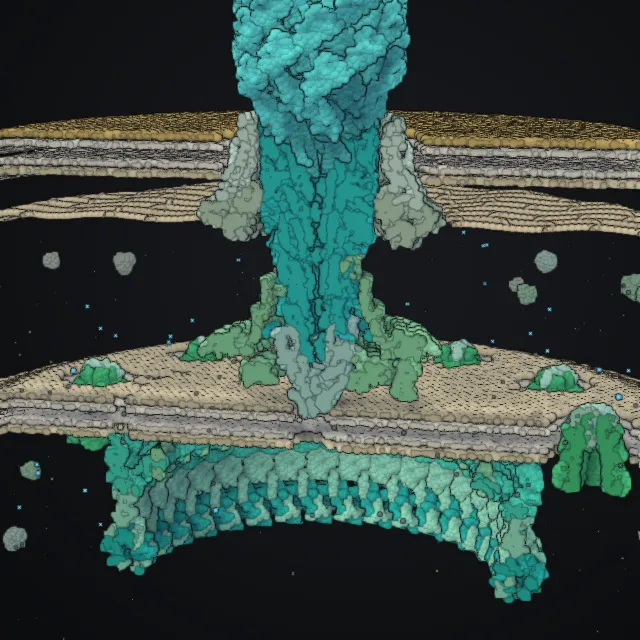
Bacterial flagellar motor
The 10 review prompts from the notes on Bacterial flagellar motor. Answer each in your head, then reveal it. Your grade decides when the card comes back.
Loading your progress…
Many bacteria swim with a few long corkscrew tails. The flagellar motor sits at the base of each tail, built into the cell wall. What does the motor do to the tail?
Unlike most motors in a cell, the flagellar motor burns no ATP. What powers it in E. coli?
A bacterium cannot see food. It swims straight for about a second, then tumbles and picks a new direction at random. Why does its motor need to reverse?
A ring of stators grips the cell wall around the motor's rotor. Each stator lets ions into the cell one at a time. What does that ion flow do to the rotor?
A signal protein carries news from the cell's sensors to the motor. When enough of it binds the rotor, what does the motor do?
Stator units join and leave the motor all the time, like workers who come and go. What makes more of them stay on the motor?
At the size of a bacterium, water feels like thick syrup. How far does a swimming cell coast after its motors stop?
Each proton that passes through a stator moves the rotor only a tiny step. Roughly how many protons does one full turn of the rotor take?
Sperm tails and the cilia in your airways are also called flagella, but no rotary motor turns them. How do they move instead?
Each extra stator unit adds push to the motor. But when the motor turns with almost no load, how fast does one stator unit spin it compared with many?
Hand off to your agent
Keep your reviews going somewhere else. The button copies a prompt for your own AI agent: where to find the 130 cards, how to schedule them, and your progress so far. The agent stores them in its own database and reminds you when cards are due.
- JSON, 0 cards
- Bacterial flagellar motor cards JSON, 10 cards
- Cards for Anki File → Import
- All cards JSON, versioned